
Free vs. Paid: Is It Worth Buying an Android Game Anymore?
The mobile gaming market has undergone an extraordinary structural transformation over the last decade. There was a time when navigating the Google Play Store felt similar to browsing a digital console shop. Players paid a flat, upfront fee, downloaded a complete software package, and enjoyed an uninterrupted entertainment experience from start to finish. Today, that premium business model represents a minuscule fraction of global mobile gaming revenue.
The modern marketplace is overwhelmingly dominated by the free-to-play model, often supported by microtransactions, battle passes, and ad networks. With thousands of high-production, visually stunning games available to download for zero dollars upfront, consumers face a valid dilemma. Does it make logical or financial sense to buy a premium Android game anymore? Answering this requires analyzing monetization design, player psychology, and changing distribution ecosystems.
The True Cost of Free-to-Play Games
The term free-to-play is frequently a marketing misnomer. While the initial entry barrier is entirely removed, allowing users to install games instantly, the underlying software architecture is meticulously engineered to encourage spending. This model has evolved from crude paywalls into highly sophisticated behavioral monetization ecosystems.
Psychological Hooks and Artificial Friction
Freemium architecture relies heavily on generating intentional inconvenience, commonly referred to as artificial friction. Developers create deliberate bottlenecks within the game loop to test a player’s patience.
-
Energy Mechanics: Limiting the number of actions or matches a player can perform in a single session before forcing a real-time cooldown period.
-
Time Gates: Requiring hours, or even days, for structural upgrades or character training to complete unless a premium currency is used to bypass the wait.
-
Difficulty Spikes: Designing sudden escalation curves where progress becomes mathematically impossible without upgrading gear, implicitly funneling players toward the in-game shop.
The Endless Live-Ops Cycle
Free-to-play titles operate as services rather than static products. Continuous updates, seasonal events, and time-limited gacha banners ensure that the game is never truly finished. While this provides a steady stream of fresh content, it shifts the competitive landscape. To maintain relevancy in multiplayer environments, players frequently find themselves trapped in a continuous spending cycle, making the lifetime cost of a single free title significantly higher than a standard upfront purchase.
The Value Proposition of Premium Android Games
In stark contrast to the freemium model, premium paid games require a one-time financial transaction to unlock full access. This foundational difference alters the entire design philosophy of the software.
Uncompromising Game Design Integrity
When a developer knows they will not receive additional funds post-purchase, their sole objective is to deliver the most engaging, cohesive, and balanced experience possible.
-
Pacing Control: Progression is dictated by player skill and narrative structure rather than predatory monetization milestones.
-
Immersion and Focus: The absence of flashing shop icons, intrusive banner advertisements, and rewarded video prompts allows for deep cognitive absorption and a pure, distraction-free atmosphere.
-
Offline Functionality: Premium titles rarely require a persistent internet connection to validate anti-piracy markers or process server-side purchases, making them highly reliable during travel or in low-connectivity environments.
Consoles and PC Port Fidelity
The modern Android ecosystem has become powerful enough to handle direct ports of highly acclaimed desktop and console games. Buying these premium versions offers remarkable value. Titles that cost thirty to forty dollars on dedicated gaming systems are frequently listed on the Google Play Store for a fraction of that price. Purchasing these games provides desktop-class physics, sophisticated narrative scripts, and complex mechanical depth directly on a handheld device without any structural compromises.
The Rise of Gaming Subscriptions: A Middle Ground
As the tension between premium costs and freemium frustrations intensifies, platform holders have introduced subscription architectures to bridge the gap. For Android users, the primary framework is Google Play Pass.
The Subscription Mechanics
For a fixed monthly or annual fee, a subscription model grants users unrestricted access to a curated catalog containing hundreds of premium games and premium versions of popular free applications.
-
Complete Unlock: All standalone upfront purchase costs are entirely waived for included titles.
-
Monetization Removal: In-app purchases are completely unlocked or bypassed, and all third-party advertising networks are programmatically stripped from the software.
-
Family Sharing: Subscriptions can be shared across multiple individual profiles within a family group, significantly reducing the per-user cost allocation.
This structural shift alters the value equation. Buying individual premium games can feel risky if the gameplay fails to resonate, but a subscription removes the financial risk of experimentation while preserving the operational benefits of premium, ad-free gaming.
Strategic Monopolization of Player Time
When deciding whether to allocate capital toward a premium purchase or stick to a free alternative, evaluating how each model respects your time is an informative diagnostic step.
| Evaluation Metric | Free-to-Play / Freemium Titles | Premium Paid Applications | Subscription Catalog Models |
| Upfront Financial Cost | Zero dollars initial investment | Fixed one-time transaction | Recurring monthly or annual fee |
| Progression Velocity | Artificially throttled by timers or paywalls | Dependent strictly on player capability | Unrestricted and fully unlocked |
| Long-Term Total Expense | Uncapped, variable through microtransactions | Absolute, capped at the initial purchase price | Predictable, fixed programmatic budgeting |
| Advertising Intrusiveness | High frequency, video and banner placement | Completely absent from software logic | Systematically stripped via platform layer |
Frequently Asked Questions
Why do premium games often appear to have lower star ratings on the Google Play Store?
Premium titles frequently suffer from volatile review scores due to hardware fragmentation across the Android ecosystem. Unlike a free game where a crash results in a simple uninstallation with no financial loss, a user who pays money for a title expects immediate operational perfection. If a premium port encounters a software conflict on a specific niche processor or screen resolution, frustrated buyers immediately leave low ratings based on technical optimization defects rather than the actual quality of the game design itself.
If a paid game gets removed from the store, do I lose access to my purchase permanently?
Not immediately. If you have already purchased and installed a premium title that a developer subsequently delists from the storefront, the application typically remains functional on your local hardware storage. Furthermore, you can usually re-download the software via your personal purchase history library within the account management tab. However, if a major Android operating system update introduces breaking architectural shifts years down the line, a delisted and abandoned game will eventually become incompatible and unplayable.
Do premium Android games support physical controllers natively?
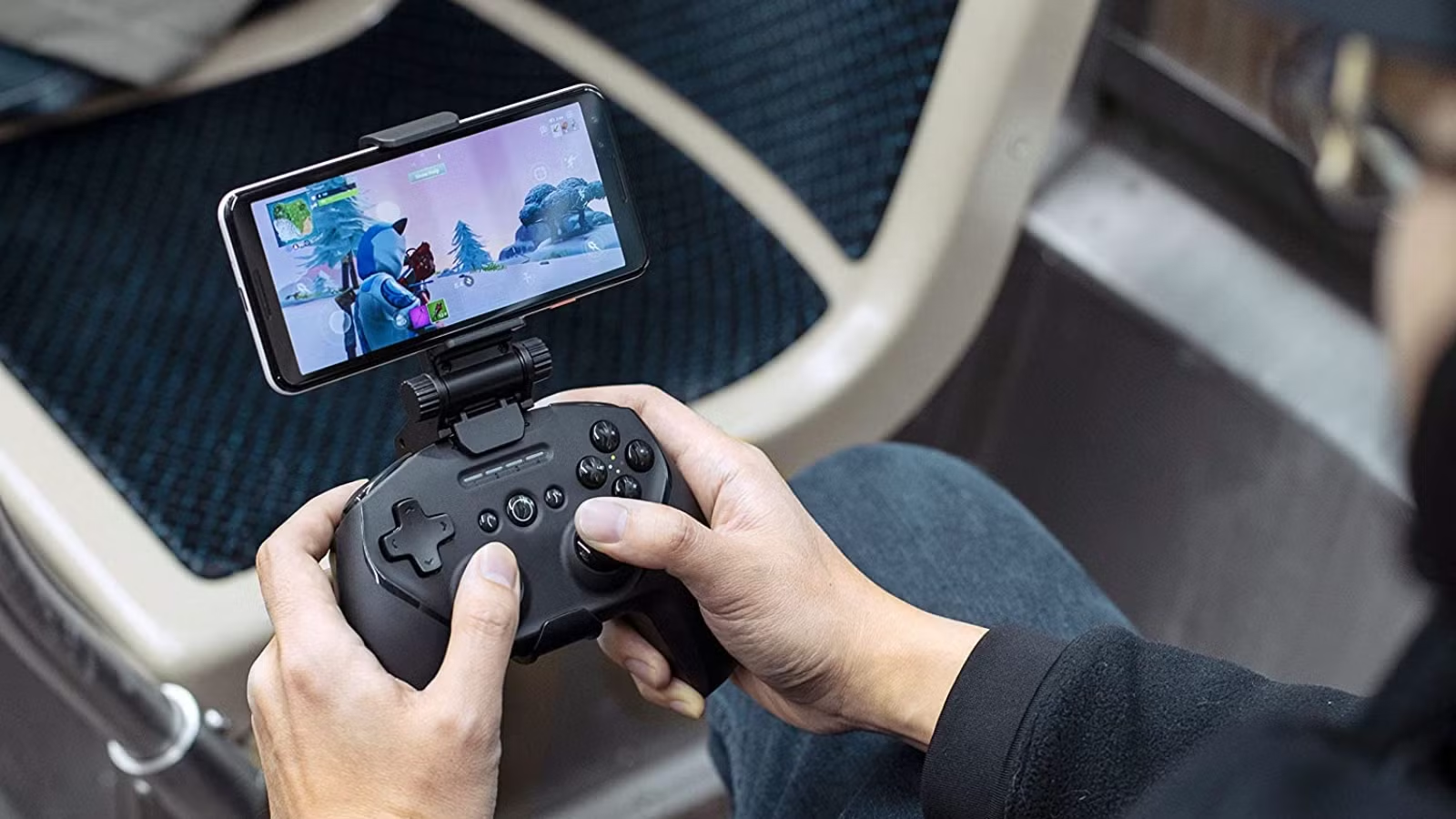
Yes, premium games are significantly more likely to feature robust, native mapping for external Bluetooth controllers compared to casual free-to-play titles. Because many premium titles are direct ports of console or PC software, the underlying input architecture is designed from the ground up for joysticks and physical triggers. This makes premium purchases highly appealing for users operating dedicated Android gaming handhelds or telescopic smartphone controller attachments.
What prevents free-to-play games from offering fair competitive matchmaking?
The commercial imperative of the freemium model creates a structural conflict of interest. To incentivize players to spend money on premium equipment, character upgrades, or stat-boosting modifiers, the game must provide a visible advantage to those who pay. If matchmaking systems were perfectly fair and segregated based purely on raw equipment attributes, the financial incentive to purchase power upgrades would disappear, crippling the developers primary monetization engine.
Can I try a paid Android game before committing to the purchase price?
While the Google Play Store does not feature a universal demo infrastructure, it implements a highly reliable, automated refund window. Upon purchasing a premium game, a prominent refund option remains visible directly on the store page for a limited duration, typically up to two hours of ownership. If the software performs poorly on your specific hardware or fails to meet your design expectations, executing a refund triggers an immediate financial reversal without requiring manual support intervention.
How do independent developers make a profit on premium Android games if the market share is so low?
Independent developers targeting the premium sector generally bypass the mass casual demographic, focusing instead on a dedicated niche of gaming enthusiasts who actively loathe freemium mechanics. Because premium titles require no ongoing expense for live-operations server scaling, localized customer service, or complex anti-cheat software, the operational overhead is drastically lower. This allows a studio to achieve financial sustainability through a modest volume of high-margin, dedicated purchases rather than chasing millions of non-paying casual installations.