

Puzzle: The Quiet Challenge that Sharpens the Mind and Soothes the Soul
In a world that often seems driven by speed, distraction, and constant stimulation, puzzles offer a rare and beautiful antidote. They invite us to slow down, to focus, and to engage deeply with a challenge that is both structured and mysterious. From ancient riddles to modern-day digital enigmas, puzzles have captivated human minds for millennia—not merely as games, but as intellectual and emotional journeys.
To define a puzzle is to touch upon a paradox: it is something we willingly choose to struggle with. Whether assembling a thousand-piece jigsaw, solving a cryptic crossword, unlocking an escape room clue, or navigating a logic problem in a mobile app, the essence of a puzzle lies in its demand for mental effort and its promise of eventual clarity. It is a challenge framed within boundaries, offering satisfaction not just in completion but in the process itself.
Historically, puzzles have been more than just leisurely diversions. They have occupied a central role in culture, education, and even philosophy. The ancient Greeks, for example, relished paradoxes and logic conundrums, using them to probe the nature of truth and reasoning. In medieval times, riddles served both as entertainment and as vehicles for moral instruction. Across cultures, puzzles have been woven into folklore, literature, and intellectual tradition—a testament to their universal appeal.
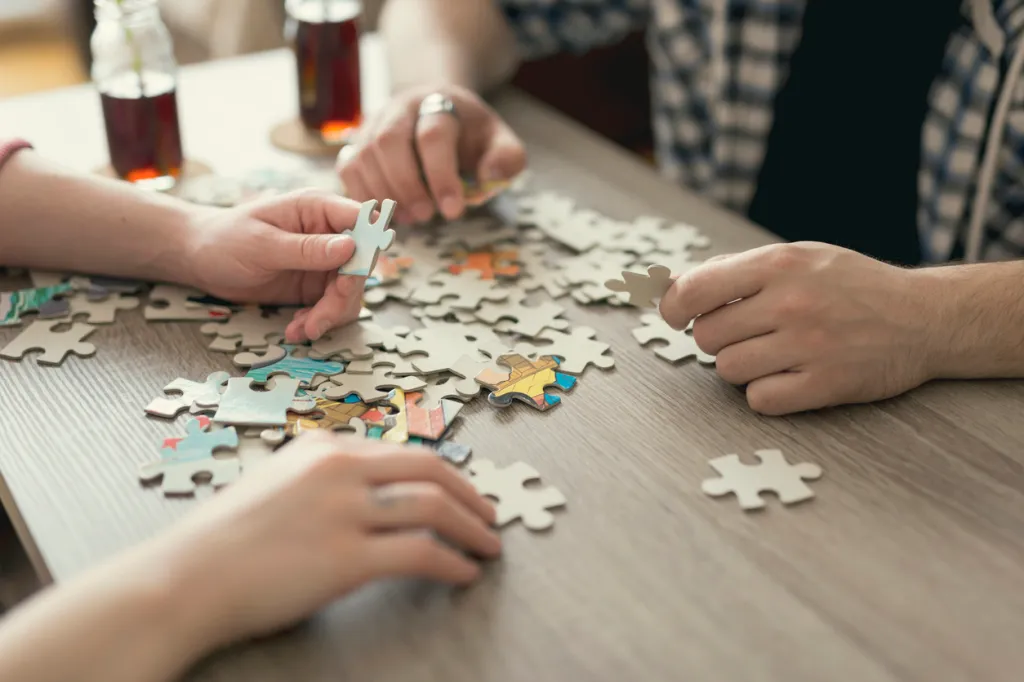
Today, puzzles manifest in myriad forms, each engaging different facets of the mind. The jigsaw puzzle, perhaps the most iconic of them all, appeals to our spatial reasoning and patience. Each piece, seemingly insignificant on its own, contributes to a greater whole. The satisfaction of placing a single correct piece is subtle yet profound—a moment of harmony between the mind’s expectation and the hand’s execution. Jigsaw puzzles also foster mindfulness, drawing attention away from the chaos of the world and into a realm where logic, color, and shape reign supreme.
Word-based puzzles such as crosswords, anagrams, and acrostics tap into our linguistic intelligence. They challenge our vocabulary, our grasp of nuance, and our memory. More than mere tests of knowledge, these puzzles reward lateral thinking—the ability to see connections between seemingly unrelated concepts. A clever clue in a well-crafted crossword can be a delight in itself, a small spark of wit shared across the printed page between creator and solver.
Then there are numerical and logical puzzles like Sudoku, Kakuro, or the many variations of logic grids. These appeal to the analytical part of the brain, demanding discipline, pattern recognition, and strategic planning. Their appeal lies in their purity: clear rules, no tricks, and a single correct answer waiting to be found through methodical reasoning. They serve not just as entertainment but as mental calisthenics, strengthening cognitive functions such as memory, concentration, and decision-making.
In the digital age, puzzles have not only survived but flourished. Apps and online platforms offer interactive and often beautifully designed puzzle experiences that blend traditional formats with innovative mechanics. Puzzle video games—from indie gems like The Witness and Baba Is You to blockbusters like Portal—combine visual art, storytelling, and intricate challenge into deeply immersive experiences. These games demonstrate that puzzles can be emotionally resonant as well as intellectually rewarding, evoking wonder, frustration, humor, and triumph.
But what is it about puzzles that continues to draw us in, across time, culture, and technology? One answer lies in the concept of flow—the psychological state of being completely absorbed in an activity. Puzzles are uniquely suited to induce this state. They provide just enough difficulty to challenge us, yet are structured enough to offer incremental rewards. This balance between challenge and attainability creates a compelling rhythm of engagement, frustration, insight, and satisfaction.
Moreover, puzzles offer a sense of control and order in an often chaotic world. Unlike many aspects of life, puzzles come with a promise: there is a solution. That certainty, however concealed, can be comforting. The process of unraveling a puzzle mimics our broader desire to understand and master the complexities around us. Each problem solved, no matter how small, affirms our ability to reason, to persist, and to discover meaning.
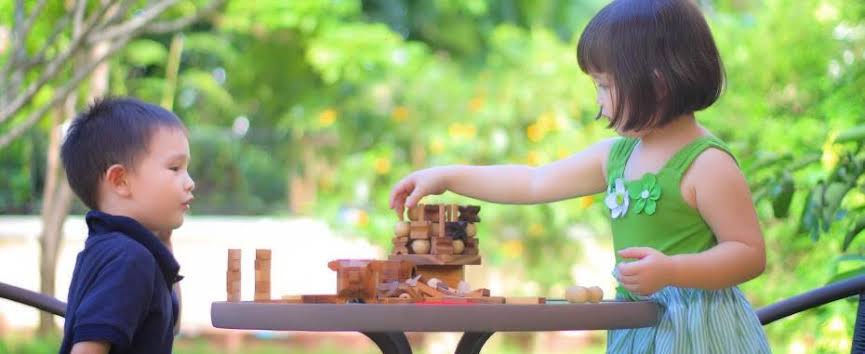
There is also a social dimension to puzzles that is frequently underestimated. Group puzzle-solving—be it in an escape room, over a crossword shared at the breakfast table, or through collaborative online forums—fosters communication, shared effort, and collective insight. It highlights the value of different perspectives and thinking styles. In a world that increasingly values diversity and cooperation, puzzles offer a metaphor and a practice for working together toward common understanding.
Interestingly, the benefits of puzzles extend well into the realm of health and wellness. Cognitive scientists have long noted that regular engagement with puzzles can delay the onset of age-related cognitive decline. They stimulate neural activity, reinforce memory circuits, and promote problem-solving skills that are transferable to real-life situations. Beyond the brain, the act of puzzling—particularly with physical puzzles—can reduce stress and anxiety, offering a tactile, grounded experience that counterbalances digital overload.
In schools, puzzles are being re-integrated as valuable teaching tools, encouraging not just rote learning but curiosity, critical thinking, and perseverance. They offer a way to make learning playful, to challenge students without intimidating them, and to build confidence through discovery. Likewise, in corporate and professional environments, puzzles are used in training and team-building exercises to cultivate creativity, collaboration, and strategic planning.
To appreciate puzzles is to celebrate the mind’s desire to make sense of the world, to find patterns, and to revel in the elegance of a well-crafted challenge. In an age of rapid information and fleeting attention, puzzles ask us to pause, to consider, and to think deeply. They reward not just quick wits but sustained thought, not just cleverness but patience.
Ultimately, the enduring appeal of puzzles lies in their simplicity and their depth. They remind us that the joy of discovery is not just in the answer but in the journey. Each puzzle, in its own quiet way, invites us to explore the limits and the wonders of our thinking—piece by piece, clue by clue, moment by moment.